Saw #5: Sagas, Languages, and Compiler Chains
1233 words • 7 min read • Abstract

Why Sharpen the Saw? — The name comes from Covey’s Habit 7: stop cutting long enough to sharpen the blade. This series tracks weekly investment in the tools themselves—compilers, languages, agent infrastructure—so the feature work that sits on top of them goes faster. Five weeks in, the dependency chains are getting shorter.
| Resource | Link |
|---|---|
| Repos & Live Demos | Table below |
| Prior Post | Saw #4: All Together Now — Emacs Meets the Multi-Agent Orchestra |
| Comments | Discord |
Saga Archiving in agentrail-rs
Agentrail-rs tracks AI agent workflows as append-only saga records. Until now, one project meant one saga directory. That breaks down when a project has multiple concurrent workstreams—say, a language project where one saga covers the parser, another the runtime, and a third the test harness.
Saga archiving adds the ability to close out a completed saga and start a new one without losing history. Archived sagas move to a timestamped subdirectory, keeping the active saga directory clean while preserving the full trajectory for later analysis or ICRL replay. MLPL is the first project using saga archiving—each phase of the language (lexer, parser, interpreter, compiler) gets its own saga, archived when complete.
Not every project needs multiple sagas. The C compiler (tc24r) uses a single ever-growing saga that accumulates GitHub issues as they arrive from downstream projects like APL and PL/SW. When an APL feature hits a codegen gap, the issue lands in tc24r’s saga and stays there until fixed. One saga, one backlog—simple and appropriate for a project driven by external bug reports rather than internal phases.
MLPL: An APL2/J/BQN-Inspired ML Language
MLPL is a new Rust-based language inspired by APL2, J, BQN, and K, purpose-built for machine learning workflows. Unlike the integer APL on COR24—which is a minimal subset running on embedded hardware—MLPL runs on Linux and Mac with full floating-point support, first-class tensors, visual debugging, and a contract-first compartmentalized architecture.
The language is being built in Rust with a phased approach: parser and AST first, then a tree-walking interpreter, then compilation. The two APL projects inform each other: operator semantics and reduction patterns tested in COR24’s constrained integer environment validate core ideas, while MLPL extends them into floating-point territory and higher-rank tensor operations that embedded hardware can’t touch. MLPL is also the proving ground for agentrail’s new saga archiving—each language phase gets its own saga with clean boundaries.
PL/SW: Macros for a PL/I-Inspired Systems Language
PL/SW is a systems programming language inspired by PL/I, targeting COR24 today with an eye toward future FPGA soft CPUs. It compiles to human-readable COR24 assembler, which means you can inspect every instruction the compiler emits.
This week’s milestone: compile-time macro metaprogramming. PL/SW macros expand at compile time and generate COR24 assembly directly, enabling:
- Hardware abstraction:
%MMIO_WRITE(addr, val)expands to the correct load/store sequence - Inline patterns: Loop unrolling and register allocation hints without runtime cost
- BASED record templates: Structured memory access patterns that the macro system can verify at compile time
The macro system is the bridge between PL/SW-as-a-language and PL/SW-as-a-systems-tool. Without it, every hardware interaction required inline assembly. With it, the language can express hardware patterns in its own syntax. The COR24 demo hub hosts the emulator where PL/SW programs run.
Fixing the C Compiler to Unblock APL
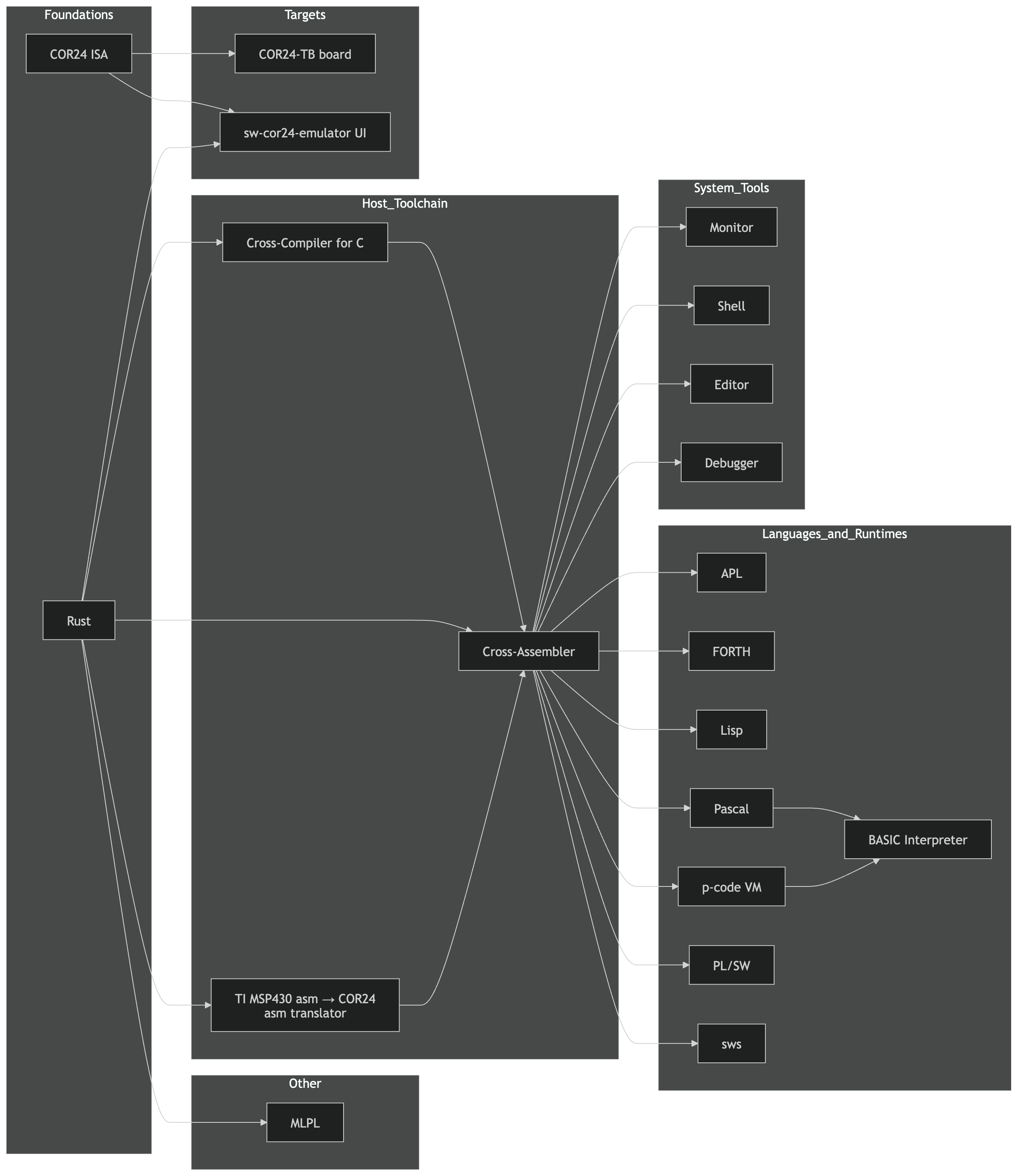
The COR24 APL interpreter is written in C and compiled by tc24r (a chibicc-inspired C compiler targeting COR24’s 24-bit RISC ISA). APL’s array operations hit several compiler gaps:
- Missing features: Certain C constructs that APL’s runtime relied on weren’t yet implemented in tc24r
- Code generation bugs: Edge cases in pointer arithmetic and array indexing produced incorrect COR24 assembly
Each fix in tc24r immediately unblocked APL features that were waiting on correct codegen. The APL REPL now handles more complex array expressions thanks to these fixes.
Extending Pascal to Unblock BASIC
A similar dependency chain on the Pascal side. The COR24 BASIC interpreter runs on a Pascal p-code VM: Pascal source compiles to p-code assembler (pa24r), links via pl24r, and executes on the COR24 virtual machine. BASIC features that need new p-code instructions require Pascal compiler work first.
The Pascal compiler extensions this round added capabilities that BASIC’s string handling and control flow were blocked on. Like the C/APL chain, every Pascal fix cascades into BASIC functionality.
Embedded Tools: Monitor, Shell, and Editor
The COR24 ecosystem also gained progress on three infrastructure tools that make the platform usable as more than a compiler target.
Monitor (sw-cor24-monitor) is the low-level system monitor—the first thing that runs on COR24 hardware. It provides memory inspection, register dumps, and direct machine-code entry. Think of it as the boot ROM’s interactive console.
Script (sw-cor24-script) is a shell and scripting environment for COR24. It gives the platform a command-line interface for running programs, piping output, and automating tasks—the glue layer between the monitor and the language tools above it.
Yocto-Ed (sw-cor24-yocto-ed) is an Emacs-inspired line editor for COR24. On embedded hardware without a full terminal, a line editor is the practical way to edit source files and configuration. Yocto-Ed borrows Emacs keybindings and concepts (kill ring, incremental search) scaled down to fit in COR24’s memory constraints.
All three are works in progress with live demos planned.
Repos and Live Demos
| Project | GitHub | Live Demo |
|---|---|---|
| agentrail-rs | sw-vibe-coding/agentrail-rs | N/A |
| APL (integer, embedded) | sw-embed/sw-cor24-apl | APL REPL |
| BASIC | sw-embed/sw-cor24-basic | future |
| COR24 Demo Hub | sw-embed/web-sw-cor24-demos | Demo Hub |
| MLPL (APL2/J/BQN, Rust, float) | sw-ml-study/sw-mlpl | future |
| Monitor | sw-embed/sw-cor24-monitor | future |
| Pascal | sw-embed/sw-cor24-pascal | Pascal Demo |
| PL/SW | sw-embed/sw-cor24-plsw | PL/SW Demo |
| Script (shell) | sw-embed/sw-cor24-script | future |
| tc24r (C compiler) | sw-embed/sw-cor24-x-tinyc | N/A |
| Yocto-Ed (line editor) | sw-embed/sw-cor24-yocto-ed | future |
What’s Next
Agentrail-rs: Multi-saga coordination—archived sagas feeding context into new ones, so an agent starting a fresh workstream can learn from completed ones.
MLPL: Parser completion and first interpreter pass. The APL operator semantics validated on COR24 hardware will inform which primitives make it into MLPL’s core.
PL/SW: Macro library for COR24 peripheral access patterns, targeting the MakerLisp hardware and eventually FPGA soft CPUs.
COR24 compilers: Continuing to close gaps in tc24r and the Pascal toolchain as APL and BASIC push further into their respective feature sets.
Sharpen the tools, shorten the chains. Follow for more Sharpen the Saw updates.
Part 5 of the Sharpen the Saw Sundays series. View all parts | Next: Part 6 →
Comments or questions? SW Lab Discord or YouTube @SoftwareWrighter.