
ML Frontier #01: Neural Collapse
736 words • 4 min read • Abstract

First Machine Learning Mondays post. ML Frontier explores cutting-edge research in machine learning.
| Resource | Link |
|---|---|
| Papers | 5 papers covered |
| Video | ML Frontier #01: Neural Collapse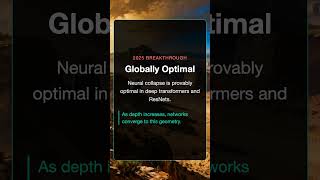 |
| Comments | Discord |
What is Neural Collapse?
During the final phase of training, deep network representations converge to a specific geometric pattern. Class means become equidistant and form a symmetric simplex structure in the feature space.
Think of it like points arranging themselves at equal distances on a sphere.
Why Does This Happen?
When networks are trained past zero training error, representations continue simplifying. The network finds the most symmetric way to separate classes, forming equal angles between all class centers.
This isn’t random—it’s mathematically optimal.
2024-2025 Breakthroughs
Recent research proves neural collapse is globally optimal in deep transformers and ResNets with regularization. As depth increases, the network provably converges to this collapsed geometry.
This changes how we think about deep learning. Collapse explains why overparameterized networks generalize well. It also guides continual learning, where progressive collapse prevents catastrophic forgetting.
Papers
| Date | Paper | Link |
|---|---|---|
| Sep 2024 | Beyond Unconstrained Features: Neural Collapse for Shallow Networks | arXiv 2409.01832 |
| Oct 2024 | Wide Neural Networks with Weight Decay Provably Exhibit Neural Collapse | arXiv 2410.04887 |
| Jan 2025 | Neural Collapse Beyond the Unconstrained Features Model | arXiv 2501.19104 |
| May 2025 | Rethinking Continual Learning with Progressive Neural Collapse | arXiv 2505.24254 |
| May 2025 | Neural Collapse is Globally Optimal in Deep Regularized ResNets and Transformers | arXiv 2505.15239 |
Paper Summaries
Beyond Unconstrained Features (Sep 2024)
Paper: Hong & Ling
In brief: Most neural collapse theory assumes you can put class markers anywhere you want—like sticking Post-it notes anywhere on a wall. But real shallow networks have limits. This paper shows neural collapse still emerges even in small networks with real data constraints, not just idealized deep networks.
Why it matters: Neural collapse isn’t just a “big model” phenomenon—it happens in smaller, practical architectures too.
Wide Networks with Weight Decay (Oct 2024)
Paper: Jacot, Súkeník, Wang & Mondelli
In brief: If you train a wide neural network with weight decay (a common regularization trick), this paper proves the network will exhibit neural collapse. It’s the first proof that end-to-end training (not just theory) leads to collapse.
Why it matters: Weight decay isn’t just preventing overfitting—it’s actively pushing the network toward optimal geometry.
Beyond the Unconstrained Features Model (Jan 2025)
Paper: arXiv 2501.19104
In brief: The “unconstrained features model” assumes networks can place representations anywhere. Real networks have architectural constraints. This paper extends neural collapse theory to realistic settings where the architecture limits what’s possible.
Why it matters: The theory holds up in real-world conditions, not just toy examples.
Progressive Neural Collapse for Continual Learning (May 2025)
Paper: arXiv 2505.24254
In brief: When you teach a network new things, it often forgets old things (catastrophic forgetting). This paper uses neural collapse to fix that: by carefully managing how class representations “collapse” over time, the network can keep learning new tasks without losing old knowledge.
Why it matters: Neural collapse isn’t just a curiosity—it’s a tool for building better learning systems.
Globally Optimal in Transformers and ResNets (May 2025)
Paper: Súkeník et al.
In brief: Imagine you have a box of crayons and need to organize them so each color is as far from every other color as possible. This paper proves that deep neural networks automatically find the best possible arrangement—not just a good one, but the mathematically perfect one. And this happens in both transformers (like GPT) and ResNets (like image classifiers).
Why it matters: It’s not a coincidence that networks learn this way. It’s provably optimal.
Key Takeaways
| Concept | One-liner |
|---|---|
| Neural Collapse | Class representations converge to symmetric simplex geometry |
| Why It Happens | Training past zero error simplifies representations maximally |
| Optimal Geometry | Provably the best configuration in deep networks |
| Practical Impact | Explains generalization and enables continual learning |
Neural collapse reveals the hidden geometry of learning. Follow for more ML Frontier episodes exploring cutting-edge research.
Part 1 of the Machine Learning Frontier series. View all parts | Next: Part 2 →
Comments or questions? SW Lab Discord or YouTube @SoftwareWrighter.