
Deepseek Papers (1/3): mHC - Training Stability at Any Depth
760 words • 4 min read • Abstract

Deepseek publishes papers. I implement them. This paper tackles a fundamental transformer problem: training stability in deep networks.
This post covers my implementation of mHC (Manifold-Constrained Hyper-Connections)—running on both Apple Silicon and NVIDIA GPUs.
| Resource | Link |
|---|---|
| Paper | arXiv:2512.24880 |
| Code | mHC-poc |
| ELI5 | eli5-mHC.md |
| ELI4 | eli4-mHC.md |
| Video 1 | mHC Demo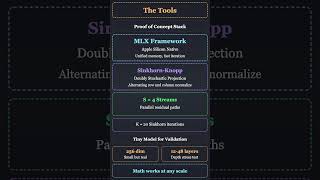 |
| Video 2 | mHC Explained |
| Video 3 | mHC Results |
The Problem: Deep Networks Explode
Residual connections revolutionized deep learning. Skip connections let gradients flow through hundreds of layers. But there’s a catch.
Standard residual connections:
output = layer(input) + input
This works, but the signal accumulates. With many layers, small amplifications compound into instability.
Hyper-Connections (HC) tried to fix this by learning connection weights:
output = α₁ × layer(input) + α₂ × input
Better expressiveness, but learned weights can still cause explosion. At 48 layers, HC becomes unstable.
The mHC Solution: Doubly-Stochastic Constraints
mHC constrains the connection weights using Sinkhorn-Knopp iteration—a mathematical technique that ensures weights form a doubly-stochastic matrix.
What does “doubly-stochastic” mean?
- Each row sums to 1
- Each column sums to 1
This bounds the total signal flow. No matter how deep the network, amplification stays controlled.
# Sinkhorn-Knopp iteration (simplified)
def make_doubly_stochastic(weights, iterations=5):
    for _ in range(iterations):
        weights = weights / weights.sum(dim=0)  # Column normalize
        weights = weights / weights.sum(dim=1)  # Row normalize
    return weights
Results: Stability at Depth
The mHC-poc repo stress-tests this with a depth sweep:
| Depth | Baseline | HC | mHC |
|---|---|---|---|
| 12 layers | Stable | Stable | Stable |
| 24 layers | Struggling | Stable | Stable |
| 48 layers | Oscillating | Explodes | Stable |
At 48 layers:
- HC gain proxy: 10²⁷ (catastrophic amplification)
- mHC gain proxy: 10⁻⁰·⁶ (bounded, healthy)
HC’s final loss at 48 layers: 5.54 (never learns) mHC’s final loss at 48 layers: 0.0002 (perfect convergence)
Cross-Platform Validation
The implementation runs on both Apple Silicon (MLX) and NVIDIA (PyTorch/CUDA):
| Metric | MLX (Apple) | CUDA (NVIDIA) |
|---|---|---|
| Gain Proxy (24L) | -0.6 | -0.602 |
| Gradient Stability | Stable | Stable |
| NaN Events | 0 | 0 |
Identical results confirm the Sinkhorn-Knopp projection works correctly on both platforms.
Running the mHC Demo
git clone https://github.com/softwarewrighter/mHC-poc
cd mHC-poc

# Apple Silicon (MLX)
uv venv && source .venv/bin/activate
uv pip install -r mlx/requirements.txt
bash scripts/run_depth_sweep.sh

# NVIDIA (CUDA)
cd cuda
uv venv && source .venv/bin/activate
uv pip install -r requirements.txt
bash scripts/run_cuda_depth_sweep.sh
Results go to runs/ with plots showing loss, gradient norms, and gain proxy across depths.
Implementation Details
| Metric | Value |
|---|---|
| Primary Language | Python |
| Source Files | 29 .py, 3 .sh, 10 .yaml |
| Estimated Size | ~2.5 KLOC |
| Frameworks | MLX, PyTorch |
| Platforms | Apple Silicon, NVIDIA CUDA |
| Key Features | Depth sweep, cross-platform validation, visualization |
Good for you if: You want to understand mHC’s stability benefits, compare MLX vs PyTorch implementations, or experiment with residual connection variants.
Complexity: Moderate. Well-documented with ELI5 explanations in docs/. Requires understanding of residual connections and matrix constraints.
Key Takeaways
-
mHC solves deep network instability. Doubly-stochastic constraints bound signal amplification at any depth.
-
Cross-platform matters. The repo runs on Apple Silicon and NVIDIA, validated to produce identical results.
-
Deepseek publishes useful research. Their papers address real problems with practical solutions.
What’s Next
Part 2 covers Engram—Deepseek’s approach to reducing redundant computation through conditional memory.
Resources
Implementing papers is the best way to understand them. Clone the repo and run the demo yourself.
Part 1 of the Deepseek Papers series. View all parts | Next: Part 2 →