How AI Learns Part 3: Weight-Based Learning
649 words • 4 min read • Abstract
Weight-based learning modifies the neural network itself.
It is slow. It is powerful. It is dangerous.
| Resource | Link |
|---|---|
| Related | Sleepy Coder: When Fine-Tuning Fails | 5MLC #3: LoRA |
The Weight-Based Methods
Pretraining
This creates the base model.
It encodes language structure, reasoning patterns, and general world knowledge. The process:
- Trains on terabytes of text
- Uses self-supervised learning (predict next token)
- Runs for weeks or months
- Costs millions of dollars
This learning is rarely repeated for cost reasons. The result is a foundation that everything else builds upon.
Fine-Tuning
Fine-tuning adapts models for specific tasks.
Standard Fine-Tuning
Adjust some or all weights using task-specific data.
Pros:
- Can significantly change behavior
- Works with small datasets
Cons:
- Risk of catastrophic forgetting
- Expensive if you modify all weights
- Hard to undo
Supervised Fine-Tuning (SFT)
Train on instruction → response pairs.
This teaches the model to:
- Follow directions
- Produce helpful outputs
- Maintain conversation structure
Risk: Can reduce other capabilities if data is narrow.
Preference Optimization
Instead of “correct answers,” train from comparisons: preferred vs rejected responses.
| Method | Description |
|---|---|
| Reinforcement Learning from Human Feedback (RLHF) | Reward model + reinforcement learning |
| Direct Preference Optimization (DPO) | Simpler alternative to RLHF |
| RLAIF | AI-generated preferences |
Pros: Strong style/safety/helpfulness steering
Cons: Can drift (“over-align”), may conflict with domain competence
Parameter-Efficient Fine-Tuning (PEFT)
Instead of changing all weights, inject small trainable modules.
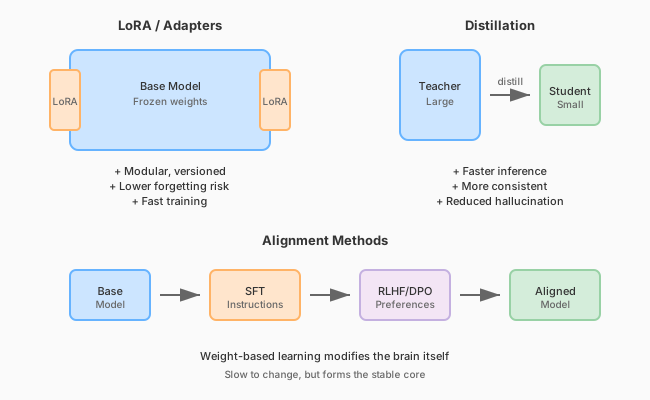
LoRA (Low-Rank Adaptation)
Insert small low-rank matrices into transformer layers. Only train these matrices.
Benefits:
- Faster training: Fewer parameters to update
- Modular: Can swap adapters
- Version control: Different adapters for different tasks
- Lower forgetting risk: Base weights frozen
Other PEFT Methods
- Prompt tuning: Learn soft prompts
- Prefix tuning: Prepend learned vectors
- Adapters: Small bottleneck layers
- IA³: Learned vectors that scale activations
Shared LoRA Subspaces
Multiple tasks share adapter subspaces to reduce interference.
Recent work (ELLA, Share) maintains evolving shared low-rank subspaces that:
- Reduce interference between tasks
- Enable continual learning
- Keep memory constant
Distillation
Train a smaller model using a larger model as teacher.
| Aspect | Teacher | Student |
|---|---|---|
| Size | Large | Small |
| Cost | High inference | Low inference |
| Knowledge | Full | Compressed |
Distillation benefits:
- Speeds up inference
- Often improves consistency
- Can reduce hallucination
- Makes deployment cheaper
This is not runtime learning—it’s offline structural learning.
The Alignment Pipeline
Modern models typically go through:
- Pretraining → General competence
- SFT → Follow instructions
- RLHF/DPO → Align with preferences
- Safety fine-tuning → Reduce harmful outputs
Each step modifies weights. Each step risks forgetting previous capabilities.
Key Insight
Fine-tuning changes the brain. RAG changes the notes on the desk.
Weight-based learning is the core capability layer. It’s slow to change, expensive to update, and risky to modify—but it forms the stable foundation that everything else builds upon.
References
| Concept | Paper |
|---|---|
| LoRA | LoRA: Low-Rank Adaptation (Hu et al. 2021) |
| RLHF | Training LMs with Human Feedback (Ouyang et al. 2022) |
| DPO | Direct Preference Optimization (Rafailov et al. 2023) |
| Distillation | Distilling Knowledge in Neural Networks (Hinton et al. 2015) |
| Adapters | Parameter-Efficient Transfer Learning (Houlsby et al. 2019) |
Coming Next
In Part 4, we’ll explore memory-based learning: RAG, CAG, Engram, and other techniques that learn without touching weights.
Change the brain carefully.
Part 3 of the How AI Learns series. View all parts | Next: Part 4 →