
Five ML Concepts - #20
461 words • 3 min read • Abstract

5 machine learning concepts. Under 30 seconds each.
| Resource | Link |
|---|---|
| Papers | Links in References section |
| Video | Five ML Concepts #20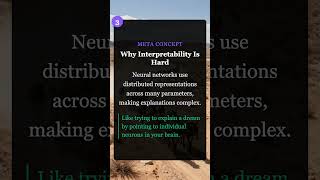 |
| Comments | Discord |
References
| Concept | Reference |
|---|---|
| VAEs | Auto-Encoding Variational Bayes (Kingma & Welling 2013) |
| Uncertainty Estimation | What Uncertainties Do We Need in Bayesian Deep Learning? (Kendall & Gal 2017) |
| Interpretability | Towards A Rigorous Science of Interpretable Machine Learning (Doshi-Velez & Kim 2017) |
| Gradient Noise | Stochastic Gradient Descent as Approximate Bayesian Inference (Mandt et al. 2017) |
| Human-in-the-Loop | Human-in-the-Loop Machine Learning (Monarch 2021) |
Today’s Five
1. Variational Autoencoders (VAEs)
VAEs are probabilistic autoencoders that learn a structured latent distribution. By sampling from that distribution, they can generate new examples similar to the training data.
The key innovation is regularizing the latent space to be smooth and continuous.
Like learning not just to summarize books, but to create new ones in a similar style.
2. Uncertainty Estimation
Models can estimate how confident they should be in predictions. Some uncertainty comes from noisy data (aleatoric), and some from limited knowledge (epistemic).
Knowing when a model is uncertain enables safer decision-making.
Like a weather forecast giving seventy percent chance of rain instead of a simple yes or no.
3. Why Interpretability Is Hard
Neural networks represent information across many interacting parameters. No single component cleanly maps to a human concept.
Distributed representations enable powerful learning but resist simple explanations.
Like trying to explain a dream by pointing to individual neurons.
4. Gradient Noise
When training with mini-batches, gradients vary from step to step. A little noise can help exploration, but too much can slow convergence.
Batch size, learning rate, and gradient clipping all influence this noise level.
Like getting slightly different directions each time you ask for help.
5. Human-in-the-Loop Systems
Humans review, supervise, or override model decisions in critical workflows. This improves safety and accountability in high-stakes applications.
The approach combines model efficiency with human judgment where it matters most.
Like a pilot monitoring autopilot and stepping in when necessary.
Quick Reference
| Concept | One-liner |
|---|---|
| VAEs | Generative models with structured latent spaces |
| Uncertainty Estimation | Know when you don’t know |
| Interpretability | Distributed representations resist explanation |
| Gradient Noise | Mini-batch variation in training |
| Human-in-the-Loop | Human oversight for critical decisions |
Short, accurate ML explainers. Follow for more.
Part 20 of the Five ML Concepts series. View all parts | Next: Part 21 →
Comments or questions? SW Lab Discord or YouTube @SoftwareWrighter.