
Five ML Concepts - #19
456 words • 3 min read • Abstract

5 machine learning concepts. Under 30 seconds each.
| Resource | Link |
|---|---|
| Papers | Links in References section |
| Video | Five ML Concepts #19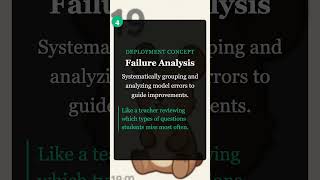 |
| Comments | Discord |
References
| Concept | Reference |
|---|---|
| Autoencoders | Reducing the Dimensionality of Data with Neural Networks (Hinton & Salakhutdinov 2006) |
| Correlation vs Causation | Causality (Pearl 2009) |
| Curriculum Learning | Curriculum Learning (Bengio et al. 2009) |
| Failure Analysis | Practical Machine Learning for Computer Vision (Lakshmanan et al. 2021) |
| Covariate Shift | Dataset Shift in Machine Learning (Quinonero-Candela et al. 2009) |
Today’s Five
1. Autoencoders
Autoencoders are neural networks trained to compress inputs into a smaller representation and reconstruct them. The bottleneck forces the model to capture essential structure.
This learned compression is useful for dimensionality reduction, denoising, and feature learning.
Like summarizing a book into key points and then rebuilding the story from that summary.
2. Correlation vs Causation
Two variables can move together without one causing the other. Models typically learn correlations present in data, not true cause-and-effect relationships.
This matters because interventions based on correlation alone may not produce intended effects.
Like noticing umbrella sales rise with rain—umbrellas don’t cause rain.
3. Curriculum Learning
Training starts with easier examples and gradually introduces harder ones. This can improve stability and learning speed in some settings.
The approach mirrors how humans learn complex subjects incrementally.
Like teaching math by starting with addition before moving to calculus.
4. Failure Analysis
Failure analysis groups model errors into categories to understand where performance breaks down. This helps target improvements instead of guessing.
Systematic error analysis often reveals actionable patterns invisible in aggregate metrics.
Like a teacher reviewing which types of questions students miss most often.
5. Covariate Shift
Covariate shift occurs when the input distribution changes between training and deployment, while the task itself remains the same. The model may underperform because it sees unfamiliar inputs.
Monitoring input distributions helps detect this shift early.
Like training a driver in sunny weather and testing them in snow.
Quick Reference
| Concept | One-liner |
|---|---|
| Autoencoders | Compress and reconstruct to learn structure |
| Correlation vs Causation | Co-occurrence isn’t cause |
| Curriculum Learning | Start easy, progress to hard |
| Failure Analysis | Categorize errors to guide fixes |
| Covariate Shift | New inputs, same task |
Short, accurate ML explainers. Follow for more.
Part 19 of the Five ML Concepts series. View all parts | Next: Part 20 →
Comments or questions? SW Lab Discord or YouTube @SoftwareWrighter.