
Five ML Concepts - #16
473 words • 3 min read • Abstract

5 machine learning concepts. Under 30 seconds each.
| Resource | Link |
|---|---|
| Papers | Links in References section |
| Video | Five ML Concepts #16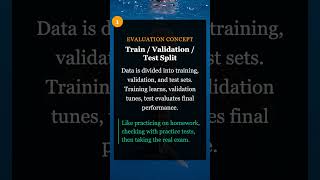 |
| Comments | Discord |
References
| Concept | Reference |
|---|---|
| Train/Val/Test Split | Deep Learning (Goodfellow et al. 2016), Chapter 5 |
| Overconfidence | On Calibration of Modern Neural Networks (Guo et al. 2017) |
| Batch Normalization | Batch Normalization: Accelerating Deep Network Training (Ioffe & Szegedy 2015) |
| Optimization vs Generalization | Understanding Deep Learning Requires Rethinking Generalization (Zhang et al. 2017) |
| A/B Testing | Controlled Experiments on the Web (Kohavi et al. 2009) |
Today’s Five
1. Train / Validation / Test Split
Data is divided into training, validation, and test sets. Training learns patterns, validation tunes hyperparameters, test evaluates final performance.
Never use test data for any decisions during development—it should only be touched once.
Like practicing on homework, checking with practice tests, then taking the real exam.
2. Overconfidence
Models can assign very high probabilities to incorrect predictions. This is often related to poor calibration and can be dangerous in high-stakes applications.
Temperature scaling and other calibration methods can help align confidence with accuracy.
Like a student who is absolutely certain of a wrong answer.
3. Batch Normalization
Normalizes layer activations during training to improve stability and convergence. Each mini-batch’s activations are normalized to have zero mean and unit variance.
This reduces internal covariate shift and often allows higher learning rates.
Like keeping everyone on a similar pace during training so no one runs too far ahead.
4. Optimization vs Generalization
Training loss can decrease while test performance does not improve. Good optimization does not guarantee good generalization.
A model can perfectly fit training data while failing on new examples—this is overfitting.
Like memorizing last year’s exam instead of understanding the subject.
5. A/B Testing Models
Comparing two model versions using controlled live traffic experiments. Users are randomly assigned to see predictions from model A or model B.
Statistical analysis determines which model performs better on real-world metrics.
Like taste-testing two recipes with real customers to see which works better.
Quick Reference
| Concept | One-liner |
|---|---|
| Train/Val/Test | Separate data for learning, tuning, and evaluation |
| Overconfidence | High probability on wrong predictions |
| Batch Normalization | Normalize activations for stable training |
| Optimization vs Generalization | Low train loss ≠ good test performance |
| A/B Testing | Compare models with live experiments |
Short, accurate ML explainers. Follow for more.
Part 16 of the Five ML Concepts series. View all parts | Next: Part 17 →
Comments or questions? SW Lab Discord or YouTube @SoftwareWrighter.