
Five ML Concepts - #15
475 words • 3 min read • Abstract

5 machine learning concepts. Under 30 seconds each.
| Resource | Link |
|---|---|
| Papers | Links in References section |
| Video | Five ML Concepts #15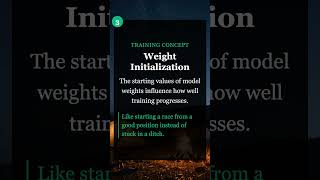 |
| Comments | Discord |
References
| Concept | Reference |
|---|---|
| Perplexity | A Neural Probabilistic Language Model (Bengio et al. 2003) |
| Catastrophic Forgetting | Overcoming Catastrophic Forgetting in Neural Networks (Kirkpatrick et al. 2017) |
| Weight Initialization | Understanding the Difficulty of Training Deep Feedforward Neural Networks (Glorot & Bengio 2010) |
| Curse of Dimensionality | The Elements of Statistical Learning (Hastie et al. 2009), Chapter 2 |
| Monitoring & Drift | Failing Loudly: An Empirical Study of Methods for Detecting Dataset Shift (Rabanser et al. 2019) |
Today’s Five
1. Perplexity
A metric for language models that reflects how well the model predicts the next token. Lower perplexity means better predictive performance.
Perplexity is the exponentiated average negative log-likelihood per token.
Like a test where lower scores mean you found the answers easier to guess.
2. Catastrophic Forgetting
When training on new tasks causes a model to lose performance on previously learned tasks. This is a key challenge in continual learning.
Techniques like elastic weight consolidation help preserve important weights.
Like learning a new phone number and forgetting the old one.
3. Weight Initialization
The starting values of model weights influence how well training progresses. Poor initialization can cause vanishing or exploding gradients.
Xavier and He initialization are common strategies for setting initial weights appropriately.
Like starting a race from a good position instead of stuck in a ditch.
4. Curse of Dimensionality
In high-dimensional spaces, data becomes sparse and distances behave differently, making learning harder. Points that seem close in low dimensions can be far apart in high dimensions.
Feature selection and dimensionality reduction help mitigate this effect.
Like searching for a friend in a city versus across the entire universe.
5. Monitoring & Drift Detection
Continuously tracking model performance and detecting shifts in input data distributions. Production models can degrade silently without proper monitoring.
Automated alerts help catch problems before they affect users.
Like a weather station alerting you when conditions change.
Quick Reference
| Concept | One-liner |
|---|---|
| Perplexity | How surprised the model is by the data |
| Catastrophic Forgetting | New learning erases old knowledge |
| Weight Initialization | Starting values affect training stability |
| Curse of Dimensionality | High dimensions make data sparse |
| Monitoring & Drift | Track performance and data changes |
Short, accurate ML explainers. Follow for more.
Part 15 of the Five ML Concepts series. View all parts | Next: Part 16 →
Comments or questions? SW Lab Discord or YouTube @SoftwareWrighter.