Five ML Concepts - #10
504 words • 3 min read • Abstract
5 machine learning concepts. Under 30 seconds each.
| Resource | Link |
|---|---|
| Papers | Links in References section |
| Video | Five ML Concepts #10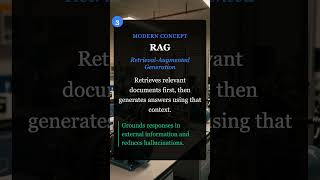 |
| Comments | Discord |
References
| Concept | Reference |
|---|---|
| CNN | ImageNet Classification with Deep Convolutional Neural Networks (Krizhevsky et al. 2012) |
| Encoder-Decoder | Sequence to Sequence Learning with Neural Networks (Sutskever et al. 2014) |
| RAG | Retrieval-Augmented Generation for Knowledge-Intensive NLP Tasks (Lewis et al. 2020) |
| Few-shot Learning | Language Models are Few-Shot Learners (Brown et al. 2020) |
| Distillation | Distilling the Knowledge in a Neural Network (Hinton et al. 2015) |
Today’s Five
1. CNN (Convolutional Neural Network)
Networks designed for image data that use small filters sliding across an image to detect edges, textures, and shapes. Early layers find simple patterns, while deeper layers recognize complex objects.
CNNs are a foundation of modern computer vision.
Like scanning a photo with a magnifying glass that learns to recognize patterns at different scales.
2. Encoder-Decoder
A model architecture with two parts: the encoder compresses input into a representation, and the decoder generates an output from that representation. This pattern is common in translation, summarization, and speech systems.
The representation acts as a bottleneck that captures essential information.
Like summarizing a book into notes, then writing a new version from those notes.
3. RAG (Retrieval-Augmented Generation)
Instead of relying only on learned parameters, the model retrieves relevant documents and uses them during generation. This helps ground responses in external information and can reduce hallucinations.
RAG combines the strengths of retrieval systems and generative models.
Like an open-book exam where you can look up facts instead of relying purely on memory.
4. Few-shot Learning
Adapting behavior from just a few examples provided directly in the prompt. Instead of retraining, the model infers the pattern and applies it to new inputs.
Zero-shot learning relies only on instructions, without examples.
Like learning a card game by watching a few hands before playing.
5. Distillation
Transferring knowledge from a large teacher model to a smaller student. The student learns to match the teacher’s outputs, not its internal weights.
This produces models that are smaller and cheaper while retaining much of the original capability.
Like an apprentice learning by imitating a master’s finished work, not by copying their brain.
Quick Reference
| Concept | One-liner |
|---|---|
| CNN | Sliding filters for hierarchical image features |
| Encoder-Decoder | Compress input, then generate output |
| RAG | Retrieve context before generating |
| Few-shot Learning | Learn from examples in the prompt |
| Distillation | Small student mimics large teacher |
Short, accurate ML explainers. Follow for more.
Part 10 of the Five ML Concepts series. View all parts | Next: Part 11 →
Comments or questions? SW Lab Discord or YouTube @SoftwareWrighter.