
Five ML Concepts - #9
475 words • 3 min read • Abstract
5 machine learning concepts. Under 30 seconds each.
| Resource | Link |
|---|---|
| Papers | Links in References section |
| Video | Five ML Concepts #9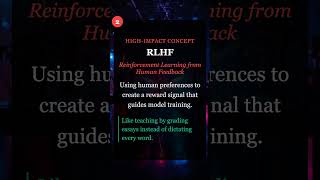 |
| Comments | Discord |
References
| Concept | Reference |
|---|---|
| Dropout | Dropout: A Simple Way to Prevent Neural Networks from Overfitting (Srivastava et al. 2014) |
| RLHF | Training language models to follow instructions with human feedback (Ouyang et al. 2022) |
| Inference | Deep Learning (Goodfellow et al. 2016), Chapter 5 |
| Quantization | A Survey of Quantization Methods for Efficient Neural Network Inference (Gholami et al. 2021) |
| Flash Attention | FlashAttention: Fast and Memory-Efficient Exact Attention (Dao et al. 2022) |
Today’s Five
1. Dropout
A regularization technique that randomly disables units during training. This encourages the network to rely on multiple pathways instead of memorizing patterns.
It helps reduce overfitting, especially in large models.
Like training a team where random members sit out each practice, so no one becomes a single point of failure.
2. RLHF (Reinforcement Learning from Human Feedback)
A training approach where humans rank or compare model outputs to produce a reward signal. The model is then optimized to better match human preferences.
This technique is central to aligning language models with human intent.
Like teaching by grading essays instead of dictating every word.
3. Inference
The process of running a trained model to make predictions on new data. Training updates the model’s parameters; inference uses them.
The distinction matters for optimization, deployment, and cost.
Like the difference between studying for an exam and actually taking it.
4. Quantization
Reducing the numerical precision used to store and compute model weights. This can shrink model size and speed up inference, sometimes with a small accuracy tradeoff.
Essential for deploying large models on limited hardware.
Like compressing a high-resolution photo into a smaller file that still looks good.
5. Flash Attention
An optimized attention algorithm designed to reduce memory usage. It avoids materializing the full attention matrix by computing attention in blocks.
This enables longer sequences and faster training.
Like reading a book chapter by chapter instead of photocopying the whole thing first.
Quick Reference
| Concept | One-liner |
|---|---|
| Dropout | Random disabling to prevent overfitting |
| RLHF | Learn from human preference comparisons |
| Inference | Using a trained model for predictions |
| Quantization | Lower precision for smaller, faster models |
| Flash Attention | Block-wise attention for memory efficiency |
Short, accurate ML explainers. Follow for more.
Part 9 of the Five ML Concepts series. View all parts | Next: Part 10 →
Comments or questions? SW Lab Discord or YouTube @SoftwareWrighter.