
Five ML Concepts - #5
498 words • 3 min read • Abstract

5 machine learning concepts. Under 30 seconds each.
| Resource | Link |
|---|---|
| Papers | Links in References section |
| Video | Five ML Concepts #5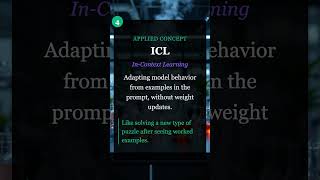 |
| Comments | Discord |
References
| Concept | Reference |
|---|---|
| Perceptron | The Perceptron: A Probabilistic Model (Rosenblatt 1958) |
| Pre-training | BERT: Pre-training of Deep Bidirectional Transformers (Devlin et al. 2018) |
| Speculative Decoding | Fast Inference from Transformers via Speculative Decoding (Leviathan et al. 2022) |
| ICL | Language Models are Few-Shot Learners (Brown et al. 2020) |
| Latent Space | Auto-Encoding Variational Bayes (Kingma & Welling 2013) |
Today’s Five
1. Perceptron
The simplest neural network: a single linear unit with weights and a bias. It computes a weighted sum and applies a threshold or activation.
It inspired modern neural networks, even though today’s models are far more complex.
Like a single voter weighing inputs before deciding yes or no.
2. Pre-training
Training a model on a large, general dataset before adapting it to a specific task. This gives the model broad patterns that later training can refine.
BERT, GPT, and most modern LLMs use this approach.
Like going to medical school before choosing a specialty.
3. Speculative Decoding
A technique where a small, fast model proposes tokens, and a larger model verifies or rejects them in parallel. This can speed up inference without changing final outputs.
A key optimization for production LLM deployments.
Like a junior writer drafting text for a senior editor to approve in batches.
4. In-Context Learning (ICL)
When a model adapts its behavior using examples in the prompt, without updating its weights. It allows flexible task behavior at inference time.
This emergent capability surprised researchers when GPT-3 demonstrated it.
Like solving a new puzzle after seeing a few worked examples.
5. Latent Space
The internal representations a model learns as it processes data. In this space, similar inputs tend to be located near each other.
It’s not a literal place, but a useful way to think about how models organize information.
Like a map where cities are arranged by similarity instead of geography.
Quick Reference
| Concept | One-liner |
|---|---|
| Perceptron | Single linear unit—the neural network ancestor |
| Pre-training | Learn general patterns before specializing |
| Speculative Decoding | Draft fast, verify in parallel |
| ICL | Adapt from prompt examples without training |
| Latent Space | Internal representations where similar things cluster |
Related Posts
- In-Context Learning Revisited: From Mystery to Engineering — A deeper exploration of how ICL evolved from emergent surprise to engineered capability.
Short, accurate ML explainers. Follow for more.
Part 5 of the Five ML Concepts series. View all parts | Next: Part 6 →
Comments or questions? SW Lab Discord or YouTube @SoftwareWrighter.