
Five ML Concepts - #4
458 words • 3 min read • Abstract
5 machine learning concepts. Under 30 seconds each.
| Resource | Link |
|---|---|
| Papers | Links in References section |
| Video | Five ML Concepts #4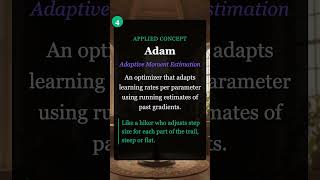 |
| Comments | Discord |
References
| Concept | Reference |
|---|---|
| Activation Functions | Deep Learning (Goodfellow et al. 2016), Chapter 6 |
| Transfer Learning | A Survey on Transfer Learning (Pan & Yang 2010) |
| VLM | Learning Transferable Visual Models (CLIP) (Radford et al. 2021) |
| Adam | Adam: A Method for Stochastic Optimization (Kingma & Ba 2014) |
| Superposition | Toy Models of Superposition (Elhage et al. 2022) |
Today’s Five
1. Activation Functions
Functions like ReLU, sigmoid, and tanh that transform neuron outputs. They introduce nonlinearity, allowing networks to learn complex patterns beyond simple linear relationships.
Without them, stacking layers would just be matrix multiplication.
Like an on-off switch that can also dim the lights.
2. Transfer Learning
Using knowledge a model learned on one task to improve performance on a related task. This often reduces training time and data requirements dramatically.
Pre-trained models can be fine-tuned for specific applications.
Like a chef who already knows French cooking learning Japanese cuisine faster.
3. VLM (Vision-Language Models)
Models trained to work with both images and text. They learn shared representations that connect visual and language understanding.
CLIP, GPT-4V, and LLaVA are examples of this approach.
Like someone who can look at a photo and describe what’s happening.
4. Adam
An optimizer that adapts learning rates for each parameter using information from past gradients. It combines ideas from momentum and adaptive learning-rate methods.
One of the most popular optimizers in deep learning.
Like a hiker who adjusts step size for each part of the trail, steep or flat.
5. Superposition
A way neural networks represent many concepts using overlapping directions in the same space. This allows models to pack more information into fewer neurons than expected.
It’s why interpretability is hard—features aren’t neatly separated.
Like discovering a painting has hidden layers that appear under the right light.
Quick Reference
| Concept | One-liner |
|---|---|
| Activation Functions | Introduce nonlinearity to enable complex patterns |
| Transfer Learning | Reuse knowledge from one task for another |
| VLM | Joint understanding of images and text |
| Adam | Adaptive per-parameter learning rates |
| Superposition | Many concepts packed into overlapping representations |
Short, accurate ML explainers. Follow for more.
Part 4 of the Five ML Concepts series. View all parts | Next: Part 5 →
Comments or questions? SW Lab Discord or YouTube @SoftwareWrighter.