
Five ML Concepts - #2
451 words • 3 min read • Abstract

5 machine learning concepts. Under 30 seconds each.
| Resource | Link |
|---|---|
| Papers | Links in References section |
| Video | Five ML Concepts #2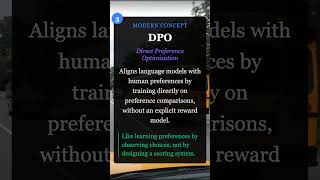 |
| Comments | Discord |
References
| Concept | Reference |
|---|---|
| Gradient Descent | An overview of gradient descent optimization algorithms (Ruder 2016) |
| Attention | Neural Machine Translation by Jointly Learning to Align and Translate (Bahdanau et al. 2014) |
| DPO | Direct Preference Optimization (Rafailov et al. 2023) |
| Learning Rate | Cyclical Learning Rates (Smith 2015) |
| Temperature | On the Properties of Neural Machine Translation (Cho et al. 2014) |
Today’s Five
1. Gradient Descent
A general optimization method used across machine learning. It improves a model by taking small steps in the direction that reduces error the most.
Many learning algorithms rely on it, especially neural networks.
Like walking downhill in fog, adjusting each step based on the slope beneath your feet.
2. Attention
A mechanism that lets models weigh different parts of the input by importance. Instead of treating everything equally, attention highlights what matters most.
This was key to breakthroughs in translation and language models.
Like reading a sentence and focusing more on the important words.
3. DPO (Direct Preference Optimization)
A method for aligning language models with human preferences. Unlike RLHF, it trains directly on preference comparisons and avoids an explicit reward model.
This simplifies training while achieving comparable alignment.
Like learning preferences by observing choices, not by designing a scoring system.
4. Learning Rate
Controls how large each update step is during training. Too large and learning becomes unstable. Too small and training is slow or gets stuck.
One of the most important hyperparameters to tune.
Like choosing how fast to walk downhill without losing balance.
5. Temperature
A parameter that controls randomness during text generation. Low temperature favors predictable, high-probability outputs. Higher temperature increases variety and surprise.
A tradeoff between consistency and creativity.
Like adjusting a dial from cautious to adventurous.
Quick Reference
| Concept | One-liner |
|---|---|
| Gradient Descent | Walk downhill to minimize error |
| Attention | Focus on what matters in the input |
| DPO | Align models from preference pairs directly |
| Learning Rate | Step size that balances speed and stability |
| Temperature | Dial between predictable and creative |
Short, accurate ML explainers. Follow for more.
Part 2 of the Five ML Concepts series. View all parts | Next: Part 3 →
Comments or questions? SW Lab Discord or YouTube @SoftwareWrighter.