
Solving Sparse Rewards with Many Eyes
1473 words • 8 min read • Abstract

Single explorer: 0% success. Five explorers: 60% success.
Learning often fails not because models are slow, but because they see too little. In sparse-reward environments, a single explorer is likely to miss the rare feedback entirely. The solution? Put many eyes on the problem.
| Resource | Link |
|---|---|
| Related | Intrinsic Rewards and Diversity |
| Papers | IRPO · Reagent |
| Code | many-eyes-learning |
| ELI5 | eli5.md |
| Video | Given enough eyeballs…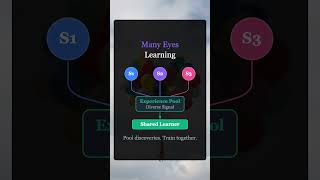 |
The Problem: Sparse Rewards Create Blindness
As IRPO formalizes: in sparse-reward RL, the true policy gradient is basically uninformative most of the time. No reward signal → no gradient signal.
A 7x7 grid with a single goal demonstrates this perfectly:
- Random agent success rate: ~9%
- With limited training (75 episodes), a single learner exploring alone never finds the goal
This isn’t a compute problem. It’s an information problem.
| Challenge | Effect | Paper Connection |
|---|---|---|
| Rare rewards | Weak gradient signal | IRPO’s core problem statement |
| Single explorer | Limited coverage | Why multiple scouts help |
| Random exploration | Misses valuable states | Why intrinsic rewards matter |
| No feedback structure | Can’t distinguish “almost right” from “nonsense” | Reagent’s motivation |
The Solution: Many Eyes
Instead of one explorer, use multiple scouts—independent exploratory agents that gather diverse information.
┌─────────────┐  ┌─────────────┐  ┌─────────────┐
│   Scout 1   │  │   Scout 2   │  │   Scout N   │
│ (strategy A)│  │ (strategy B)│  │ (strategy N)│
└──────┬──────┘  └──────┬──────┘  └──────┬──────┘
       │                │                │
       v                v                v
┌─────────────────────────────────────────────────┐
│              Experience Buffer                   │
└─────────────────────────────────────────────────┘
                       │
                       v
┌─────────────────────────────────────────────────┐
│               Shared Learner                     │
└─────────────────────────────────────────────────┘
Each scout explores with its own strategy. Their discoveries are aggregated to improve a shared learner.
Results
On a 7x7 sparse grid with 75 training episodes:
| Method | Success Rate |
|---|---|
| Random baseline | 9% |
| Single scout | 0% |
| Many eyes (3 scouts) | 40% |
| Many eyes (5 scouts) | 60% |
Same total environment steps. Dramatically better outcomes.
Why It Works
Single Scout Fails Because:
In IRPO terms: sparse reward → sparse gradient signal → no learning.
- Random exploration rarely reaches the goal (~9%)
- Insufficient successful trajectories
- DQN can’t learn from sparse positive examples
- The policy gradient has near-zero magnitude
Many Eyes Succeeds Because:
IRPO’s key insight: multiple exploratory policies manufacture signal.
- More coverage: Different scouts explore different regions (intrinsic rewards drive novelty-seeking)
- More discoveries: Higher probability of reaching goal (scouts find extrinsic reward)
- Signal routing: Scout discoveries update the shared learner (surrogate gradient in IRPO, experience pooling in many-eyes)
- Better gradients: Aggregated experience provides meaningful learning signal
Scout Strategies (Intrinsic Rewards)
IRPO uses intrinsic rewards to drive exploration. The many-eyes-learning project implements several strategies:
| Strategy | Intrinsic Motivation | IRPO Connection |
|---|---|---|
| Epsilon-greedy | Random action with probability ε | Simple exploration noise |
| Curious | Bonus for novel states: 1/√(count+1) |
Count-based intrinsic reward |
| Optimistic | High initial Q-values | Optimism under uncertainty |
| Random | Pure random baseline | Maximum entropy exploration |
# CuriousScout intrinsic reward (simplified)
def intrinsic_reward(self, state):
    count = self.state_counts[state]
    return self.bonus_scale / sqrt(count + 1)
Scouts can be homogeneous (same strategy, different seeds) or heterogeneous (different strategies). IRPO supports swapping intrinsic reward functions—many-eyes makes this concrete with pluggable scout types.
Running the Demo
git clone https://github.com/softwarewrighter/many-eyes-learning
cd many-eyes-learning

# Setup
uv venv .venv
source .venv/bin/activate
uv pip install -e ".[dev]"

# Interactive CLI demo
python experiments/cli_demo.py

# Full experiment
python experiments/run_experiment.py --episodes 75 --scouts 1 3 5

# Generate plots
python experiments/plot_results.py
Results appear in ~5-10 minutes on a laptop.
Diversity Experiment
Does diversity of strategies matter, or just number of scouts?
| Configuration | Success Rate |
|---|---|
| 5 random scouts | 20% |
| 5 epsilon-greedy scouts | 40% |
| 5 diverse scouts (mixed strategies) | 40% |
Finding: In simple environments, strategy quality matters more than diversity. Epsilon-greedy beats random regardless of diversity.
Key Insight
The problem isn’t that learning is slow. The problem is that learning is blind.
Many eyes make learning better.
Implementation Details
| Metric | Value |
|---|---|
| Primary Language | Python |
| Source Files | ~12 .py files |
| Estimated Size | ~1.5 KLOC |
| Framework | PyTorch, NumPy |
| Platform | CPU (no GPU required) |
Good for you if: You want to understand exploration in RL, experiment with sparse-reward environments, or see a clean implementation of scout-based learning.
Complexity: Low-Moderate. Clean codebase with CLI demos. Runs on a laptop in minutes.
Design Philosophy
The project prioritizes clarity over performance:
- Single-file implementations where practical
- Minimal dependencies
- Sequential mode is first-class (parallel optional)
- Reproducible experiments with fixed seeds
Simplifications from IRPO
Full IRPO computes Jacobians to route gradients from exploratory policies back to the base policy. Many-eyes-learning simplifies this:
| IRPO | Many-Eyes-Learning |
|---|---|
| Jacobian chain rule | Experience pooling |
| Surrogate gradient | Standard DQN updates |
| Learned intrinsic rewards | Hand-designed strategies |
The core insight remains: scouts explore with intrinsic motivation, discoveries benefit the shared learner. The math is simpler, the demo runs on a laptop, and the concept is clear.
Key Takeaways
-
Sparse rewards create information bottlenecks. Learning fails not from lack of compute, but lack of signal.
-
More eyes = more information. Multiple scouts increase coverage and discovery rate.
-
Diversity helps, but quality matters more. In simple environments, good exploration strategy beats diversity.
-
Same compute, better outcomes. Many-eyes improves sample efficiency, not wall-clock speed.
The Papers Behind Many-Eyes
This project builds on two recent papers that attack the same fundamental problem: sparse rewards starve learning of signal.
IRPO: Intrinsic Reward Policy Optimization
IRPO (Cho & Tran, UIUC) formalizes the scouts concept mathematically.
The core insight: In sparse-reward RL, the true policy gradient is basically uninformative most of the time. No reward signal → no gradient signal. Learning stalls.
IRPO’s solution:
┌─────────────────────────────────────────────────┐
│  1. Train exploratory policies (scouts)         │
│     using INTRINSIC rewards                     │
├─────────────────────────────────────────────────┤
│  2. Scouts discover EXTRINSIC rewards           │
│     through exploration                         │
├─────────────────────────────────────────────────┤
│  3. Route extrinsic signal back to base policy  │
│     via surrogate gradient (Jacobian chain)     │
└─────────────────────────────────────────────────┘
| IRPO Concept | What It Means |
|---|---|
| Intrinsic rewards | “Explore what’s new” - reward novelty |
| Exploratory policies | Scouts driven by intrinsic motivation |
| Surrogate gradient | Trade bias for signal - approximate gradient that actually has magnitude |
| Base policy | The learner that benefits from scout discoveries |
How many-eyes-learning demonstrates this:
- Scouts implement intrinsic motivation (CuriousScout uses count-based novelty bonuses)
- Multiple exploration strategies create diverse coverage
- Aggregated experience routes discoveries to the shared DQN learner
- Simplified gradient routing - we pool experiences rather than compute full Jacobians
Reagent: Reasoning Reward Models for Agents
Reagent (Fan et al., CUHK/Meituan) takes a different approach: make feedback richer and more structured.
The problem with sparse rewards: They can’t distinguish “almost right, failed at the end” from “complete nonsense.” Both get the same zero reward.
Reagent’s solution: Build a Reasoning Reward Model that emits:
| Signal | Purpose |
|---|---|
<think> |
Explicit reasoning trace |
<critique> |
Targeted natural-language feedback |
<score> |
Overall scalar reward |
This provides dense-ish supervision without hand-labeling every step.
How many-eyes-learning relates:
- Both papers recognize sparse rewards as an information problem
- Reagent enriches the reward signal; IRPO multiplies the exploration
- Many-eyes takes the IRPO path: more explorers finding the sparse signal
- Future work could combine both: scouts + richer feedback per trajectory
The Shared Meta-Lesson
Both papers are saying the same thing:
Sparse signals are a tragedy. Let’s smuggle in richer ones.
- IRPO: via intrinsic-reward exploration gradients
- Reagent: via language-based reward feedback
Many-eyes-learning demonstrates the IRPO intuition in a simple, visual, reproducible way.
Resources
- IRPO Paper (arXiv:2601.21391)
- Reagent Paper (arXiv:2601.22154)
- many-eyes-learning Repository
- Results Documentation
- Architecture Documentation
Sparse rewards are an information problem. Many eyes provide the solution.
Part 1 of the Machine Learning series. View all parts | Next: Part 2 →