
Small Models (2/6): AI in Your Pocket
765 words • 4 min read • Abstract

AI on your phone. All day. No internet required.
This is Part 2 of the Small Models, Big Brains series. Today we’re putting a language model in your pocket with Pocket Eliza++—a modern AI therapist that runs completely offline on Android.
| Resource | Link |
|---|---|
| Paper | MobileLLM (ICML 2024) |
| Code | pocket-llm |
| Runtime | llama.cpp |
| Video | AI in Your Pocket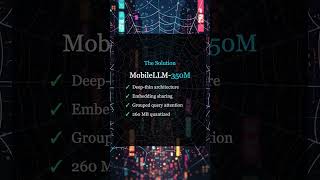 |
Why Offline Matters
| Benefit | Description |
|---|---|
| Privacy | Data never leaves your device |
| Speed | No network latency |
| Cost | No API fees |
| Offline | Works without internet |
| Battery | Efficient on-device inference |
Cloud AI is convenient, but sometimes you want a conversation that stays on your device.
MobileLLM: Meta’s Edge Champion
MobileLLM is Meta’s sub-500M parameter model optimized specifically for on-device inference.
Architecture Optimizations
| Technique | Benefit |
|---|---|
| Deep-thin design | More layers, fewer parameters per layer |
| SwiGLU activation | Better performance than ReLU |
| Embedding sharing | Saves 30% of parameters |
| Grouped-query attention | Faster inference |
The result: a 260MB quantized model (Q4_K_M) that runs smoothly on phones.
Pocket Eliza++

The original ELIZA (1966) used pattern matching to simulate a Rogerian therapist. Pocket Eliza++ uses the same therapeutic approach but with actual language understanding.
Therapeutic Design
The system prompt instructs the model to:
- Ask one short question at a time
- Never repeat questions
- Vary question types (feelings, motivations, specifics)
- Never give advice or explanations
It’s a reflective listener, not a problem solver.
Technical Stack
┌─────────────────────────────────┐
│     Kotlin + Jetpack Compose    │  UI Layer
├─────────────────────────────────┤
│            JNI Bridge           │
├─────────────────────────────────┤
│           llama.cpp             │  Inference Engine
├─────────────────────────────────┤
│    MobileLLM-350M (Q4_K_M)      │  Model (260MB)
└─────────────────────────────────┘
- Model: MobileLLM-350M quantized to Q4_K_M (260MB GGUF)
- Runtime: llama.cpp compiled for Android via NDK
- Interface: Kotlin + Jetpack Compose
- Bridge: JNI bindings connect Kotlin to native llama.cpp
Building the App
# Clone the repository
git clone https://github.com/softwarewrighter/pocket-llm
cd pocket-llm/android-demo

# Clone llama.cpp into native source
git clone https://github.com/ggerganov/llama.cpp.git \
    app/src/main/cpp/llama.cpp

# Download the model (260MB)
mkdir -p app/src/main/assets
curl -L -o app/src/main/assets/MobileLLM-376M-Q4_K_M.gguf \
    "https://huggingface.co/pjh64/MobileLLM-350M-GGUF/resolve/main/MobileLLM-376M-Q4_K_M.gguf"

# Build and install
./gradlew assembleDebug
adb install -r app/build/outputs/apk/debug/app-debug.apk
Build Requirements
| Requirement | Value |
|---|---|
| Target SDK | 35 (Android 15) |
| Min SDK | 28 (Android 9.0) |
| ABI | arm64-v8a |
| NDK | CMake for native build |
| Kotlin | 2.0.0 |
Quick CLI Demo
Don’t want to build the Android app? Test with Ollama:
pip install -r requirements.txt
ollama pull smollm:360m
python3 eliza.py
Performance
On a mid-range Android phone (Snapdragon 7 series):
- First token: ~500ms
- Generation: ~10 tokens/second
- Memory: ~400MB RAM
- Battery: Minimal impact for short sessions
Implementation Details
| Metric | Value |
|---|---|
| Languages | Kotlin (UI), Python (CLI), C++ (JNI) |
| Source Files | 6 .kt, 4 .py, 2 .cpp |
| Estimated Size | ~1.3 KLOC |
| Android Target | SDK 28+ (Android 9.0) |
| Build System | Gradle + CMake (NDK) |
| Key Dependency | llama.cpp (vendored) |
Good for you if: You want to deploy LLMs on Android, learn JNI/NDK integration, or build privacy-focused mobile AI apps.
Complexity: Moderate-High. Requires Android Studio, NDK setup, and understanding of JNI bridges. The llama.cpp integration is the tricky part; the Kotlin UI is straightforward Jetpack Compose.
Key Takeaways
-
Sub-500M models are phone-ready. MobileLLM proves useful AI fits in your pocket.
-
llama.cpp is the universal runtime. Same engine runs on Mac, Linux, Windows, and Android.
-
Privacy doesn’t require sacrifice. Offline AI can still be conversational and helpful.
-
Quantization is essential. Q4_K_M brings 350M parameters down to 260MB with minimal quality loss.
What’s Next
Part 3 explores the Hierarchical Reasoning Model (HRM)—a 27M parameter model that beats o3-mini on abstract reasoning.
Resources
- MobileLLM Paper (ICML 2024)
- pocket-llm Repository
- llama.cpp
- MobileLLM GGUF on HuggingFace
- Video: AI in Your Pocket
Part 2 of the Small Models, Big Brains series. View all parts | Next: Part 3 →